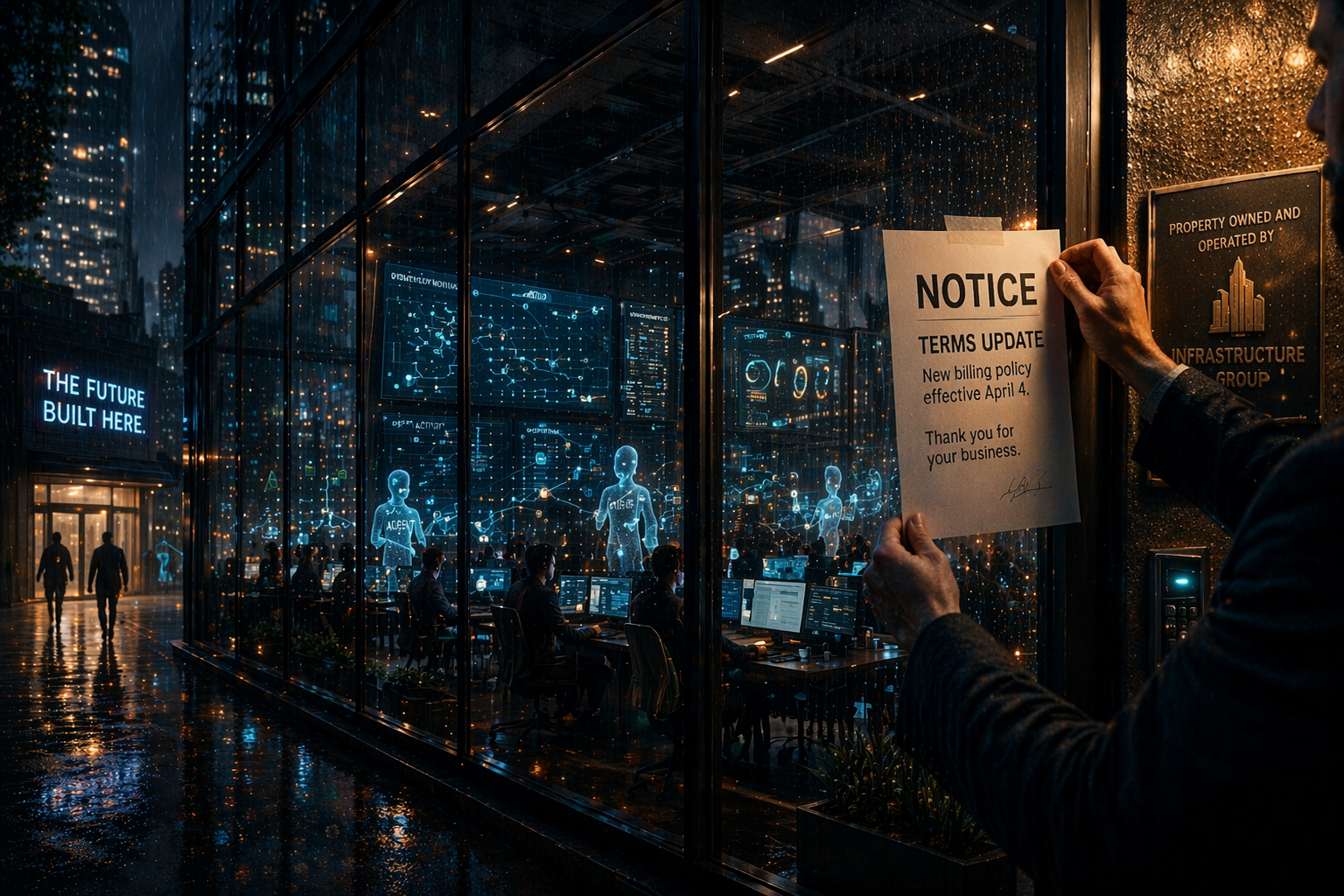
On April 4, thousands of AI agent workflows were disrupted overnight. Not because the agents broke. Because a vendor changed its billing policy. That’s not a technology failure. It’s a governance one.
April 4
One email. Effective that day. One week’s notice.
Anthropic ended subscription access for third-party harnesses, starting with OpenClaw and extending to all of them shortly after. Over 135,000 OpenClaw instances were running at the time. Developers and organizations behind them suddenly had a choice: pay-as-you-go at API rates, pre-purchase usage bundles, or figure out an alternative fast.
For some, it was a minor inconvenience. For others… the ones who had quietly built production workflows on the assumption that a flat monthly subscription covered everything… it was a scramble. Which agents were affected? Which workflows depended on this? What does the new pricing actually cost us at our usage levels?
Most organizations couldn’t answer those questions quickly. That’s the problem worth talking about.
The agents didn’t break. The billing relationship underneath them changed. Same result.
What This Actually Exposed
This wasn’t a technology failure. It was three governance failures stacked on top of each other.
Nobody knew what depended on what. If you had an agent registry, a real one and not a spreadsheet someone made in March, you could pull up every workflow running through a third-party harness and know in minutes what was affected. Most organizations couldn’t. They spent the weekend in Slack threads and support queues figuring out what broke and why. The inventory problem isn’t abstract — this is what it looks like when it’s real.
Nobody was tracking the cost. A single agentic workflow running continuously can burn $1,000 to $5,000 per day at API rates. Flat-rate subscriptions made that invisible. Nobody had modeled what happened when the subsidy went away, because nobody knew there was a subsidy. Token burn is a new category of operational cost that doesn’t appear on most IT risk registers. It needs to.
Nobody treated the vendor relationship as a vendor relationship. The model provider. The harness. The hosting platform. The MCP servers your agents are connecting to. These are critical infrastructure dependencies. Most organizations haven’t applied standard vendor management discipline to them… documented dependencies, change notification expectations, fallback options identified, governance review cadence. Because they didn’t think of it as infrastructure. They thought of it as a tool someone on the team was using.
Your Digital Workforce Has a Landlord
Every agent in your digital workforce runs on infrastructure someone else controls.
When that infrastructure changes… pricing, availability, policy, terms of service… your workforce is affected. With whatever notice the vendor chooses to give.
This isn’t new. It’s the same vendor dependency risk IT has managed for decades with SaaS platforms and cloud providers. What’s new is that most organizations haven’t applied that discipline to their AI infrastructure. The agents proliferated faster than the governance thinking.
The organizations that knew immediately on April 4 which workflows were affected are the ones that had done the work. They had registries. They had dependency maps. They had fallback options already identified. For everyone else, it was a weekend debugging session and an uncomfortable conversation about what else might be quietly depending on infrastructure nobody had mapped.
The Broader Signal
Anthropic is the first major provider to make this call explicitly. They won’t be the last.
The economics of flat-rate subscriptions subsidizing agentic usage patterns don’t work at scale. Every major AI provider is going to face this reckoning. The organizations that treat April 4 as a one-time billing inconvenience will get surprised again. The ones that treat it as a signal will start building the governance infrastructure their digital workforce actually needs.
Three things worth doing now:
Update your agent registry to capture infrastructure dependencies. Which model provider, which harness, which billing relationship sits underneath each agent workflow. If you don’t have a registry — Part 1 of this series makes the case for why that’s the foundation everything else sits on — this is the moment to start one.
Build cost governance for agents. Token burn needs a budget owner, a monitoring mechanism, and a threshold that triggers a review. It’s operational cost. Treat it like one.
Apply standard vendor management discipline to AI infrastructure. Documented dependencies. Change notification expectations in vendor agreements where possible. Fallback options identified before you need them. A review cadence that catches changes before they catch you. The same identity and access principles that apply to agents themselves — covered in Part 3 — apply equally to the infrastructure underneath them.
The Question Worth Asking Now
If your primary AI model provider changed its pricing or terms tomorrow with one week’s notice… which of your agent workflows would stop, what would it cost to continue them, and who in your organization would know first?
Most organizations can’t answer that cleanly. April 4 is a preview of what happens when the answer stays murky.
Managing the Digital Workforce | Companion