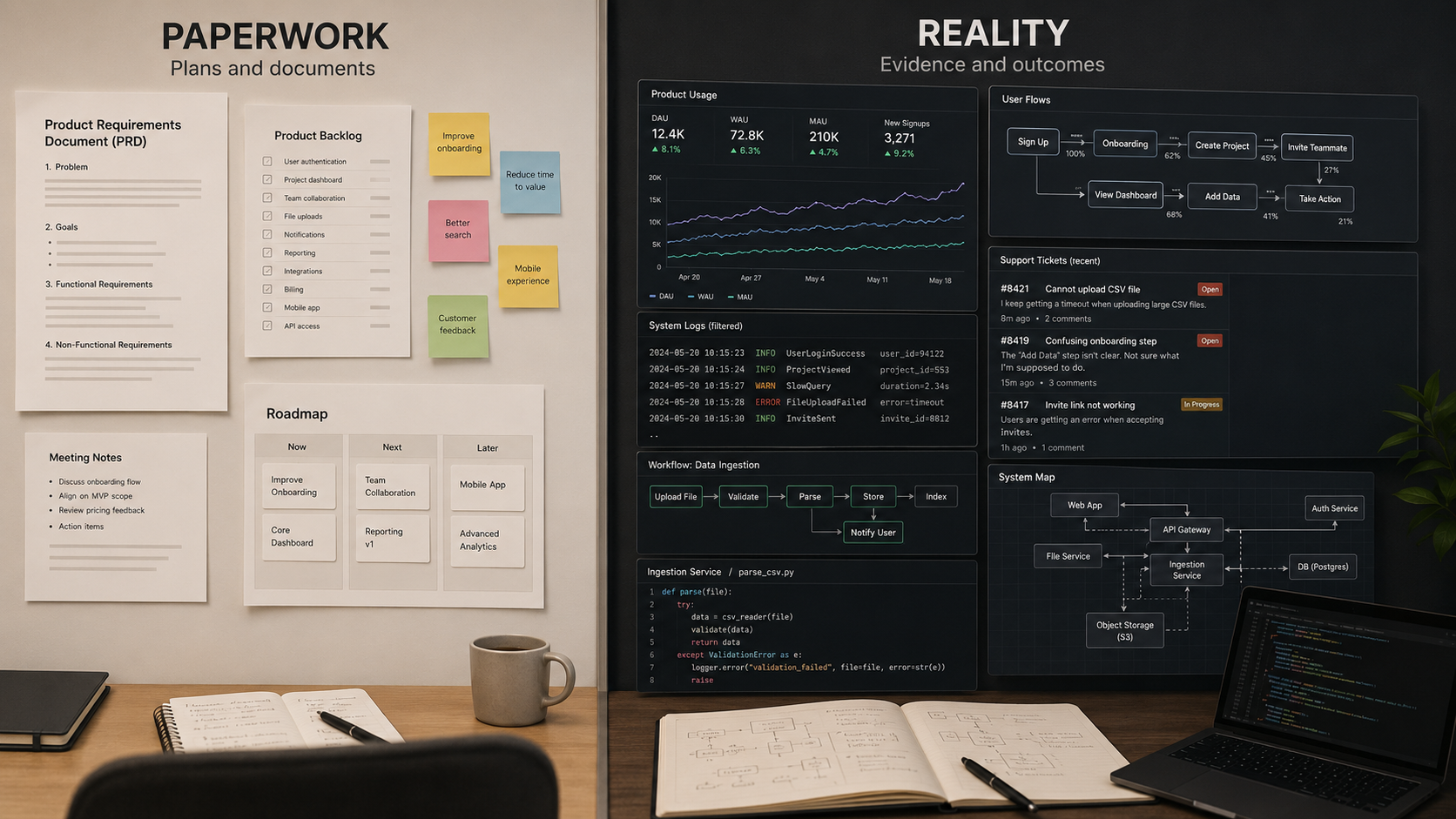
Most takes on AI and product management are about faster output. The bigger shift is cheaper understanding.
A product manager has a question. Why does this number look wrong on the dashboard, or what does this part of the product actually do when a customer hits it a certain way. It isn’t a question they can answer themselves, so they do the normal thing. They file it with engineering and wait.
Two days. Three. The answer comes back when someone has time, filtered through what that person happens to remember about code they may not have touched in a year. By then the decision that needed it has either slipped or been made on a guess. Sometimes the guess was fine. Sometimes it shipped, and the cost of being wrong turned up months later wearing the disguise of a different problem.
For most of the history of product management, that waiting was just the job. Understanding the system meant borrowing someone else’s time, so you rationed your questions and padded your timelines around the wait. It didn’t feel like a problem. It felt like how things worked.
It isn’t how things work anymore, and that’s the actual change underneath the noise about AI and product management.
Paperwork or reality
Ask what AI does for product managers and you’ll hear a familiar list. Faster PRDs. Faster stories. Cleaner summaries. The meeting turned into action items, the backlog reformatted, the release notes generated. Prettier artifacts, produced quicker.
All of it is real, and most of it is the cheap part. These are accelerators bolted onto the easiest piece of the job. The writing was always the last five percent, the tail end of a hard process, and speeding it up changes nothing that mattered.
Here’s the blunt version. Most teams are using AI to make PMs faster at paperwork, when the shift worth having makes them faster at understanding reality. Reading the system directly instead of waiting for a description of it. Checking how a feature is actually used instead of arguing from assumptions. Testing whether an idea survives contact with the real data before anyone builds it.
The first pass is yours now
A roadmap fight runs for two planning cycles. Rebuild a feature everyone “knows” is underused, or leave it. Plenty of opinion, no data. The PM finally pulls the usage instead of arguing it one more time, and the feature isn’t underused at all. It’s used constantly by a small set of the highest-value accounts and ignored by everyone else. The rebuild everyone wanted would have broken the experience for exactly the customers the business could least afford to annoy. Two cycles of debate, settled in the time it took to run a query nobody had bothered to run.
That’s the move. The PM does the first pass themselves. Not just usage data, either. The logs when a behavior doesn’t add up. The support history when you want to know what’s actually breaking for people rather than what got escalated loudest. The code itself when the real question is what the system does today. The evidence that used to sit behind someone else’s access and someone else’s calendar is now something a PM can reach into directly, in the moment they have the question instead of three days later.
I’ve made this case from the system side, that the undersold use of AI is comprehension, not generation, and watched a team call a subsystem too complicated to touch only because the people who understood it were gone. Same shift, pointed at the PM’s own job. The question that cost three days of someone else’s time can often be answered in an afternoon of yours.
What the job becomes
When the scarce thing stops being scarce, the job moves off of it.
If understanding is no longer the bottleneck, then a PM’s value isn’t being the person who slowly accumulated the context and could recite it in a meeting. It’s judgment. Picture two versions of the same PM. One spends the week turning other people’s explanations into tidy documents and chasing context they were never handed. The other spends it reading the system, pulling the numbers, and arriving at every conversation already holding the evidence. The first looks busier. The second is the one whose calls hold up, because they were made against what’s real instead of what someone half-remembered.
The sharpest version of that judgment is knowing what not to build, which is the piece AI is worst at and the piece that pays the most. A model will happily help you specify, prototype, and ship the wrong thing, quickly and in clean prose. Deciding it’s the wrong thing, and owning that call, is the work that was always the work.
Aiming it at the wrong half
The teams that treat AI as a paperwork accelerator are pointing the most capable tool they’ve been handed at the least valuable part of the job. They’ll get faster stories and a tidier backlog, they’ll feel productive, and the work that actually gates good product decisions, understanding the system, the data, and the user firsthand, will sit right there, newly cheap, untouched, because nobody reframed the question from “how do we write faster” to “how do we understand faster.”
The gap compounds quietly. The paperwork-fast team ships on worse evidence and mistakes the speed for progress, until a few confident decisions turn out to have rested on assumptions nobody checked. That cost never shows up in the sprint. It shows up later, in the thing that got built well and shouldn’t have been built at all.
The PMs who get faster at typing will save a few hours. The ones who get faster at understanding will be doing a different job.